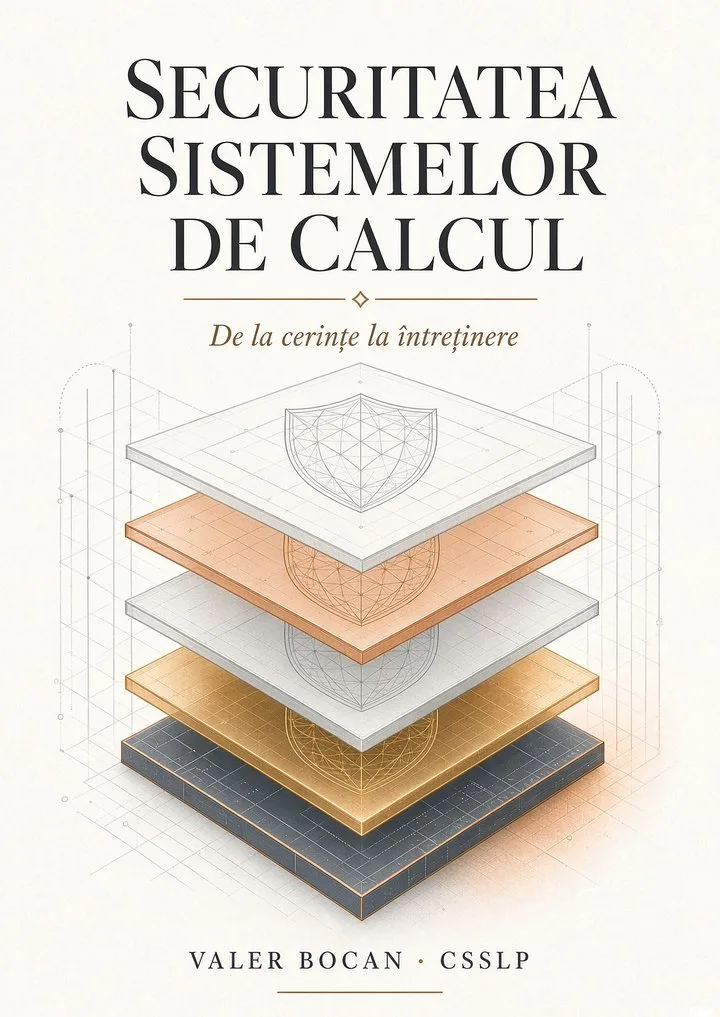
Securitatea sistemelor de calcul
De la modelele de amenințări la răspunsul la incidente, cu fiecare mecanism construit și spart în cod.
Date
Despre carte
O tratare de nivelul unui curs complet a securității sistemelor de calcul, care pornește de la modelarea riscurilor și a amenințărilor (STRIDE, DREAD, arbori de atac) și continuă cu criptografia, infrastructura cu chei publice, autentificarea și securitatea rețelelor, a aplicațiilor, a bazelor de date și a platformelor cloud și de containere, încheind cu răspunsul la incidente, criminalistica digitală și conformitatea cu GDPR, NIS2, DORA și AI Act.
Fiecare capitol îmbină teoria cu exerciții practice în C#/.NET, sprijinite de un depozit însoțitor verificat, iar un fir comun construiește, de-a lungul a șase ședințe, un honeypot funcțional. Scrisă pentru studenții din anul al treilea de la Calculatoare și pentru practicienii care vor să înțeleagă cum funcționează un atac, nu doar cum se numește.
Cuprins
titluri în limba engleză
Foundations
- 1Introduction to Computer Systems SecurityWhy Security Matters · What We Protect: The CIA Triad · Who Has Access and How We Prove What They Did · Design Principles · Security Frameworks · Classifying Information and Assets
- 2Risk ManagementWhat Risk Means · The Risk Management Process · Measuring Risk: In Money or on Scales · The Risk Matrix and the Risk Register · Treating Risks · Standards: Which Methodology When
- 3Threat Analysis and Attack ModelingWho Attacks and Where They Get In · Modeling the System: Data-Flow Diagrams · What Can Go Wrong: STRIDE · Attack Trees · From Threats to Security Requirements · Threat Modeling as a Continuous Process
- 4The Human Factor in SecurityThe Psychology of Security · The Mechanics of Social Engineering · Attack Channels · Human Error and Secure Interface Design · Security Awareness Programs · The Insider Threat
Mechanisms
- 5CryptographyWhat It Means for a Cipher to Be Secure · Symmetric Cryptography: AES and Modes of Operation · Public-Key Cryptography · Hash Functions and Message Authentication · Password Storage · Digital Signatures
- 6Public-Key Infrastructure and Cryptographic ProtocolsKey Management and Distribution · Digital Certificates and Certificate Authorities · Key Exchange Protocols · SSL/TLS · IPsec · SSH
- 7Authentication and Access ControlThe Password, a Weak Factor Used Well · The Second Factor and Phishing Resistance · Access Control Models · Identity Inside the Organization · Federated Identity: SAML, OAuth 2.0, and OpenID Connect · The Operating System, Foundation of the Other Controls
Systems
- 8Network SecurityLayers, Zones, and Segments · Protocols Built on Trust · Attacks on Availability · Filtering and Detection · Virtual Private Networks · Wireless Networks
- 9Application SecuritySecurity in the Development Lifecycle · Common Vulnerabilities: OWASP Top 10:2025 · API Security · Secure Programming · The Software Supply Chain · Security Testing and the DevSecOps Pipeline
- 10Database SecurityLayers of Defense and Hardening · Access Control · Data Encryption · Auditing · Preventing SQL Injection
- 11Cloud and Container SecurityWho Is Responsible for What: Shared Responsibility · Isolation: From Virtual Machine to Container · The Image: What Reaches Production · Running the Container · Kubernetes Security · The Cloud Virtual Network
Operations and Context
- 12Security Monitoring and HoneypotsFrom Logs to Correlation: SIEM Systems · Normal Behavior and Deviations · Alerts Nobody Reads · Honeypots · Designing a Safe Honeypot · From Raw Data to Threat Intelligence
- 13Incident Management and Digital ForensicsPreparation: The Plan, the Team, and Communication · The Response Framework, Classification, and Triage · Digital Evidence · Analysis: The Live System, Memory, and the Network · Post-Incident Analysis · Business Continuity and Disaster Recovery
- 14Physical SecurityWhere and How a Data Center Is Built · Equipment, from Procurement to Disposal · How Availability Is Designed · Physical Access and Environmental Protection
- 15Legal and Compliance AspectsGDPR and Personal Data Protection · The NIS2 Directive · Romanian Legislation · Standards and Certifications · Organizational Security Policies · Ethical Aspects
- 16Trends and Perspectives in SecurityIoT Security · Artificial Intelligence in Security · Post-Quantum Cryptography · Zero Trust Architecture
Anexe
- ASetting Up the C# Development Environment
- BWireshark Quick Guide
- CDocker and Docker Compose Quick Guide
- DDrawing Diagrams with draw.io
Recenzii
„Lucrarea Securitatea sistemelor de calcul vine să acopere o lipsă reală din literatura tehnică de limbă română. Cititorul are la dispoziție o prezentare unitară a domeniului, care pornește de la principiile fundamentale și ajunge până la practica profesională curentă.”
„În opinia mea, principalul merit al cărții este acela că prezintă securitatea sistemelor de calcul ca pe un ansamblu de probleme interdependente. […] În același timp, legătura permanentă dintre teorie și aplicațiile practice conferă lucrării o utilitate reală pentru pregătirea viitorilor ingineri.”
Citare
@book{bocan2026security,
  author    = {Bocan, Valer},
  title     = {Securitatea sistemelor de calcul},
  publisher = {Editura Politehnica},
  address   = {Timișoara},
  year      = {2026},
  pages     = {559},
  isbn      = {978-606-35-0690-1},
  language  = {romanian},
  note      = {In press}
}